

Are you curious about how much Mailchimp will cost you and what you get for your money? Understanding Mailchimp pricing can be tricky, especially when you want to make sure you’re investing in the right plan for your business.
Whether you’re just starting out or looking to scale your marketing efforts, knowing which option fits your needs and budget is crucial. You’ll discover the different Mailchimp pricing plans, what features each includes, and how you can get the most value from them. Ready to find the perfect plan that turns your customer data into real revenue? Check out Mailchimp’s latest offers and start your 14-day free trial† today by clicking here: Mailchimp Pricing. Don’t miss out on unlocking powerful tools like generative AI features, enhanced automations, and personalized onboarding that can take your email marketing to the next level. Keep reading to make the smartest choice for your business!
Credit: louder.online
Introduction To Mailchimp Pricing
Mailchimp pricing can impact your marketing budget and results. Understanding its structure helps you pick the right plan. This section explains what Mailchimp offers and why pricing matters.
Overview Of Mailchimp And Its Purpose
Mailchimp is a popular email marketing platform. It helps businesses turn customer data into revenue. Users can create personalized campaigns with ease.
- Offers generative AI features for smart automation
- Provides custom-coded email templates and popup forms
- Includes actionable insights for audience growth and conversion
- Supports personalized onboarding to guide new users
Mailchimp suits small to medium businesses wanting to improve customer engagement. It offers a free plan and paid tiers for advanced tools.
Why Understanding Pricing Matters For Users
Mailchimp pricing depends on your email list size and feature needs. Costs rise as your contacts grow.
Key reasons to understand pricing:
- Budget Control: Avoid unexpected expenses as your list expands.
- Feature Access: Choose a plan that fits your marketing goals.
- Plan Flexibility: Switch between Free, Essentials, and Standard plans.
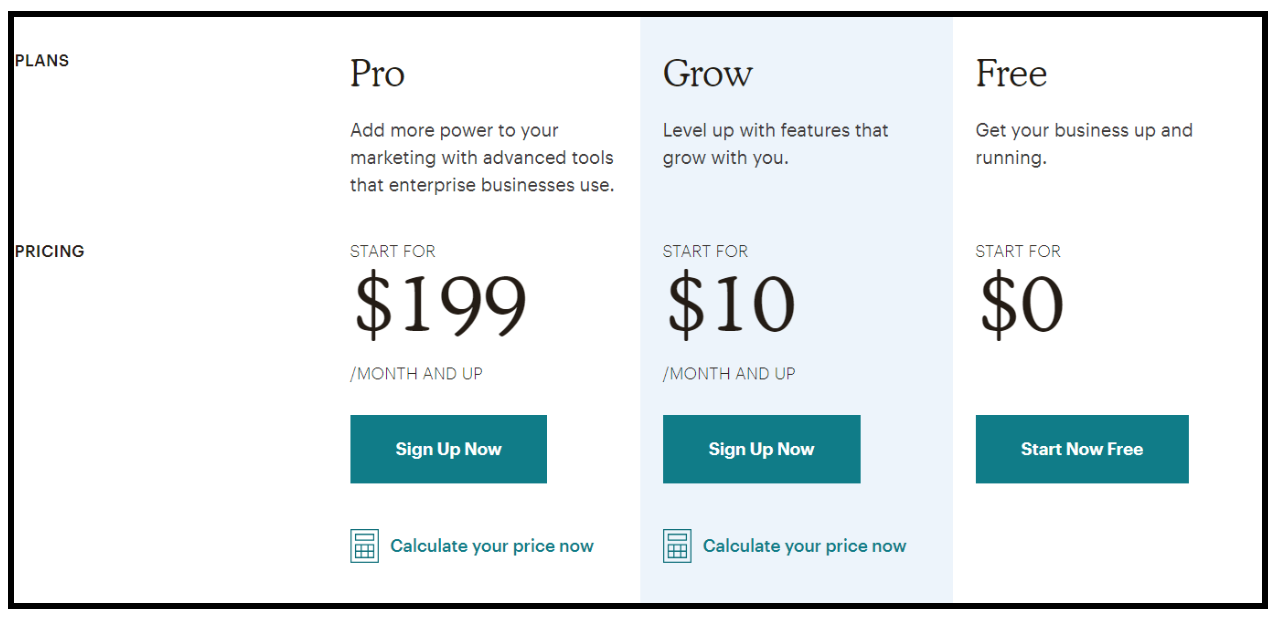
| Plan | Price (Starting) | Main Features |
|---|---|---|
| Free | $0/month | Basic email campaigns, limited contacts, simple automations |
| Essentials | Starts at $9.99/month | More emails, 24/7 support, A/B testing |
| Standard | Starts at $20/month | Advanced automations, custom templates, AI insights |
Understanding these details helps you pick a plan that fits your needs. It ensures you get value without overpaying.
Key Features Influencing Mailchimp Pricing
Mailchimp pricing depends on several key features. These features shape the overall cost and value you get. Understanding these helps you choose the best plan for your needs.
Contact Management And Its Impact On Cost
Mailchimp charges based on the number of contacts in your audience. Every contact adds to your monthly fee, even if some are inactive or duplicates.
Costs rise quickly as your list grows. This makes efficient contact management crucial to control expenses. Removing inactive or duplicate contacts can save money.
- Contacts include subscribers, leads, and customers
- Duplicate contacts count separately in billing
- Cleaning lists helps reduce costs
Email Marketing Tools And Automation Features
Mailchimp offers email marketing tools like customizable templates, campaign scheduling, and segmentation. These tools are part of all plans but vary by tier.
Automation features improve with higher plans. You get access to advanced workflows, personalized emails, and AI-driven insights as you upgrade.
| Feature | Free Plan | Essentials | Standard | Premium |
|---|---|---|---|---|
| Email Templates | Basic | Custom Coded | Custom Coded | Custom Coded |
| Automation | Basic | Advanced | Enhanced | Full Suite |
| AI Features | Limited | Limited | Generative AI | Generative AI |
Integrations And Add-ons That Affect Pricing
Mailchimp connects with many apps and platforms. These integrations add value but can affect cost if you use paid add-ons.
Popular integrations include e-commerce platforms, CRMs, and social media tools. Some require higher-tier plans or extra fees.
- Third-party app connections
- Custom API access for developers
- Paid add-ons like additional seats or advanced reporting
User Experience And Platform Usability
Mailchimp’s interface is user-friendly but can feel clunky for some. The ease of use varies by plan, with personalized onboarding in higher tiers.
Better usability helps you save time and avoid errors. This can justify the cost of upgraded plans offering improved support and training.
- Simple drag-and-drop email builder
- Personalized onboarding on Standard and Premium plans
- Customer support improves with plan level
Detailed Breakdown Of Mailchimp Pricing Plans
Mailchimp offers several pricing plans to fit different business needs. Each plan includes unique features and limits. This section explains the details of each plan and what you get at each price point.
Free Plan: Features And Limitations
The Free Plan is ideal for small businesses or beginners. It allows you to send up to 10,000 emails per month to 500 contacts. Key features include:
- Basic email templates
- Marketing CRM tools
- Simple automations
- Basic reporting
- Single-step automations
Limitations include lack of advanced targeting, no custom branding removal, and limited customer support.
Essentials Plan: Benefits And Costs
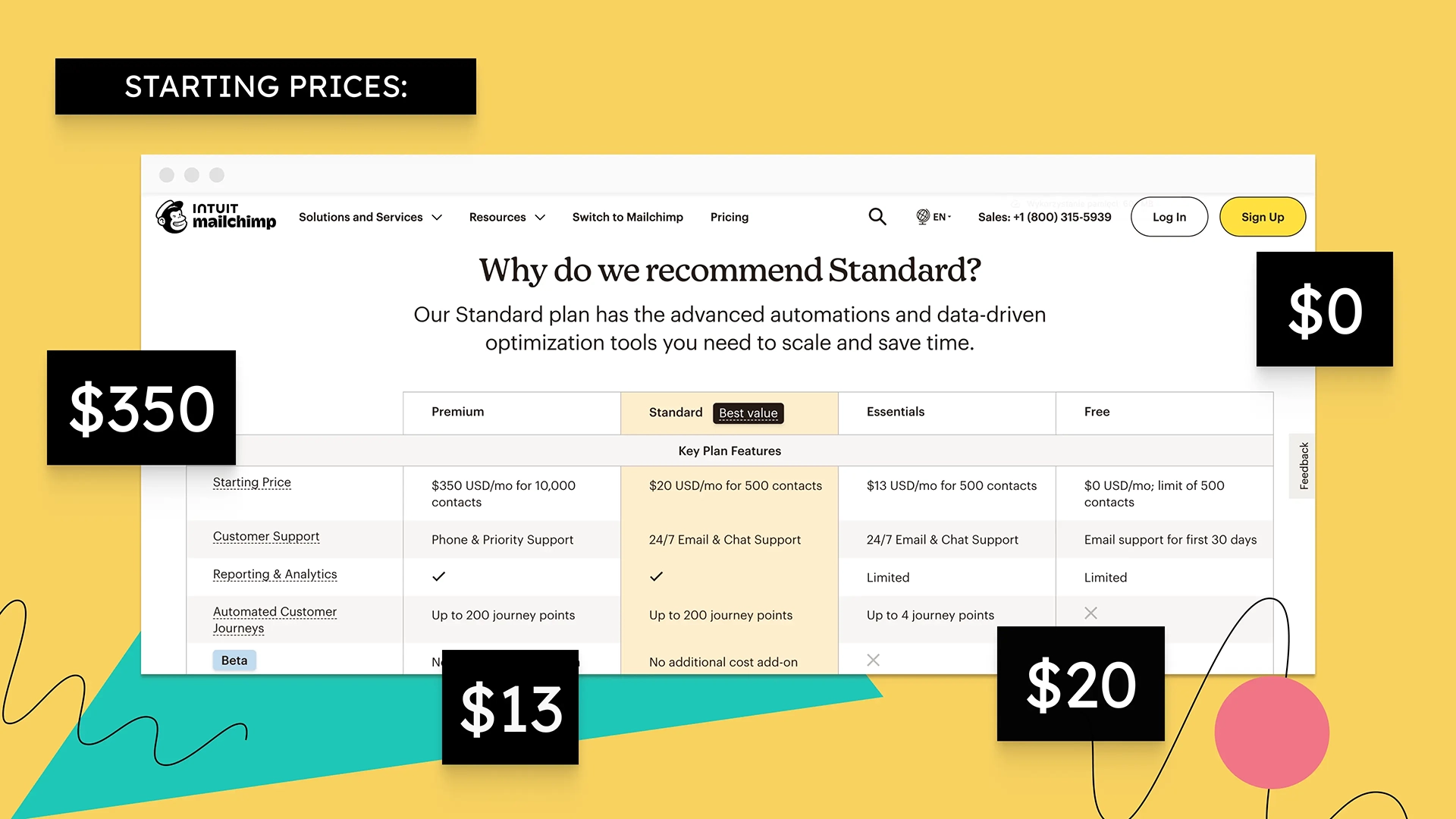
The Essentials Plan starts at $13/month and suits growing businesses. It supports up to 50,000 contacts and allows up to 500,000 emails per month. Features include:
- All Free Plan features
- Custom email templates
- 24/7 email and chat support
- A/B testing
- Remove Mailchimp branding
This plan offers more flexibility and better support compared to the Free Plan.
Standard Plan: Advanced Tools And Pricing
The Standard Plan$20/month. It includes enhanced marketing tools for businesses needing automation and data insights. Features include:
- All Essentials Plan features
- Advanced audience insights
- Behavioral targeting
- Custom-coded email templates
- Retargeting ads
- Improved automation workflows
This plan is suitable for marketers looking for smarter campaigns.
Premium Plan: Full Suite And Price Considerations
The Premium Plan targets large businesses and costs from $350/month. It provides the full range of Mailchimp features, such as:
- All Standard Plan features
- Advanced segmentation
- Multivariate testing
- Unlimited seats and role-based access
- Phone support
- Predictive analytics
This plan suits enterprises needing high-volume email marketing with deep analytics.
Hidden Costs: Duplicate Contacts, Cleaned Contacts, And Overages
Mailchimp charges for duplicate contacts and cleaned contacts—emails that bounce or unsubscribe but still count towards your total. This can increase your billing unexpectedly.
Other hidden costs include:
- Contact overages: Extra fees if your contacts exceed your plan limit.
- Email overages: Charges apply if you send beyond the monthly email quota.
- Advanced features: Some AI-powered tools and customizations may add to costs.
Careful list management helps avoid these extra expenses.
Pros And Cons Of Mailchimp Pricing Based On Real-world Usage
Mailchimp offers a variety of pricing plans suited to different business sizes and needs. Understanding the advantages and drawbacks of its pricing helps users decide if it fits their budget. Real-world users report mixed experiences, especially as their email lists grow. This section breaks down the key points about Mailchimp pricing.
Advantages Of Mailchimp’s Pricing Model
- Free Plan Availability: Start without paying, ideal for small lists and beginners.
- 14-Day Free Trial: Try the Standard plan to test advanced features risk-free.
- Scalable Plans: Options to upgrade or downgrade at any time keep flexibility high.
- Generative AI Features: Included in higher plans, provide smart insights and automation.
- Personalized Onboarding: Helps new users quickly learn to use the platform effectively.
- Customizable Tools: Custom-coded email templates and popup forms add branding control.
Common Drawbacks And Cost-related Complaints
Many users find Mailchimp pricing expensive compared to competitors. The main issues include:
- Charges on Duplicate Contacts: Paying for the same contact multiple times increases costs unfairly.
- Billing for Cleaned Contacts: Even contacts that are inactive or bounced are counted in pricing.
- Sharp Cost Increase: Prices rise steeply as email lists grow beyond free limits.
- Clunky User Experience: Some users report difficulty navigating pricing tiers and features.
How Pricing Affects Growing Email Lists
Mailchimp’s pricing structure strongly impacts businesses with expanding lists. Below is a summary of cost changes by list size:
| Email List Size | Approximate Monthly Cost | Plan Impact |
|---|---|---|
| Up to 500 contacts | Free | Basic features, limited automation |
| 501 – 2,000 contacts | $20 to $50 | Access to Standard plan features and AI tools |
| 2,001 – 10,000 contacts | $75 to $200+ | Costs increase rapidly, advanced automations |
| Above 10,000 contacts | Varies, can be very high | Enterprise-level pricing, custom plans |
Growing lists often push users to higher-priced tiers. This can strain budgets, especially for startups or small businesses.
Comparing Mailchimp With Alternatives On Pricing And Features
Mailchimp is a popular email marketing platform known for its ease of use and rich features like generative AI, customizable templates, and enhanced automations.
Its pricing, however, can be steep, especially as your contact list grows. Many users face higher costs due to charges on duplicate or cleaned contacts. This pushes businesses to explore alternatives that offer similar or better features at a lower cost.
The following sections compare Mailchimp with other email marketing tools, grouped by their pricing and feature focus.
Affordable Alternatives With Similar Features: Mailerlite, Moosend, Brevo
| Platform | Starting Price | Key Features | Best For |
|---|---|---|---|
| MailerLite | Free up to 1,000 subscribers | Drag-and-drop editor, automation, landing pages | Small businesses and beginners |
| Moosend | Free up to 1,000 subscribers | Advanced automation, AI-powered recommendations | Growing businesses seeking AI tools |
| Brevo (formerly Sendinblue) | Free up to 300 emails/day | Email marketing, SMS campaigns, transactional emails | Businesses needing multi-channel campaigns |
These options offer solid email marketing tools at lower costs than Mailchimp. Their free plans help startups and small teams save money.
E-commerce Focused Alternatives: Klaviyo, Omnisend
- Klaviyo: Designed for online stores, it integrates deeply with platforms like Shopify and WooCommerce.
- Omnisend: Combines email, SMS, and push notifications targeting e-commerce sales.
Both platforms provide features such as advanced segmentation, product recommendations, and cart abandonment emails. Their pricing scales based on contacts and message volume, often offering better ROI for e-commerce.
Advanced Automation And Crm Alternatives: Activecampaign, Hubspot
- ActiveCampaign: Combines email marketing with CRM and powerful automation workflows. Pricing starts affordably but grows with contacts and features.
- HubSpot: Offers a free CRM integrated with marketing tools. Advanced automation and analytics come with paid plans.
These platforms suit businesses wanting full customer management alongside email marketing. They provide detailed tracking and personalization beyond Mailchimp’s standard offerings.
Specialized Options For Creators And Simple Campaigns: Convertkit, Constant Contact
| Platform | Pricing | Features | Ideal User |
|---|---|---|---|
| ConvertKit | Free up to 1,000 subscribers; paid starts at $15/month | Simple automation, landing pages, tagging | Creators, bloggers, small teams |
| Constant Contact | Starts at $9.99/month | Easy-to-use editor, event marketing, surveys | Small businesses needing simple campaigns |
These tools focus on ease and speed for users running simple campaigns or building personal brands. They are less complex than Mailchimp yet cover essential email marketing needs.

Credit: bestcrmexperts.com
Recommendations For Ideal Users And Scenarios
Mailchimp’s pricing plans suit different users and business needs. Each plan offers unique features that fit specific goals. Understanding who benefits most helps choose the right plan. Knowing when to switch and how to match plans to business size saves money and effort.
Who Benefits Most From Mailchimp’s Pricing Plans
Small businesses and startups find the Free and Essentials plans useful. These plans provide basic email marketing tools without high costs. Freelancers and solopreneurs also gain from easy-to-use templates and simple automations.
Growing companies need more features. The Standard plan offers enhanced automations, custom-coded templates, and AI-powered insights. These tools help improve audience engagement and conversions.
- Frequent email senders benefit from detailed analytics and personalization.
- Businesses with expanding contact lists get value from scalable pricing.
- Marketing teams appreciate customizable pop-up forms and onboarding support.
When To Consider Switching To Alternatives
Mailchimp may become expensive as contact lists grow. It charges for duplicate and cleaned contacts, increasing costs unnecessarily. User experience issues can slow down workflows for some.
Consider alternatives if:
- Your contact list is very large and costs rise sharply.
- You need smoother CRM integration beyond Mailchimp’s capabilities.
- Pricing plans lack flexibility for your unique marketing needs.
- You want advanced features at a lower price.
Some competitors offer better pricing and effortless CRM connections. Evaluating other tools helps find a better fit for your budget and workflow.
Choosing The Right Plan Based On Business Size And Needs
| Business Size | Recommended Plan | Key Features | Ideal Use Cases |
|---|---|---|---|
| Freelancers / Solopreneurs | Free Plan | Basic email templates, limited automations, free trial | Simple email marketing, low-volume lists |
| Small Businesses | Essentials Plan | More templates, A/B testing, email support | Growing lists, basic automation needs |
| Medium Businesses | Standard Plan | Advanced automations, AI insights, customizable forms | Personalized campaigns, audience growth focus |
| Large Businesses | Consider Alternatives or Premium Plans | Scalable pricing, CRM integrations, detailed analytics | High-volume campaigns, complex marketing workflows |
Choosing depends on list size, feature needs, and budget. Start small and upgrade as marketing demands grow. Monitor costs closely to avoid unexpected price jumps.
Conclusion: Making An Informed Decision On Mailchimp Pricing
Choosing the right Mailchimp pricing plan affects your marketing success and budget. Understanding the costs and features helps you pick the best fit. This section summarizes key pricing points and shares tips to manage expenses while getting the most value.
Summary Of Key Pricing Insights
Mailchimp offers several plans to suit different business needs:
- Free Plan: Limited features, ideal for small lists and beginners.
- Essentials Plan: Starts at around $13/month with more email sends and support.
- Standard Plan: About $20/month, adds automation and advanced audience insights.
- Premium Plan: Higher cost, designed for large lists and advanced analytics.
Costs rise quickly as your contact list grows. Mailchimp charges for all contacts, including duplicates and inactive ones. This can increase your monthly bill unexpectedly.
Tips For Managing Costs And Maximizing Value
Keep your Mailchimp costs under control and get the best value with these tips:
- Clean your contact list regularly. Remove duplicates and inactive emails to avoid paying for unused contacts.
- Start with a free or Essentials plan. Upgrade only when you need more features or a larger audience.
- Use automation wisely. Automations can save time but may add to costs if overused.
- Take advantage of the 14-day free trial. Test Standard features before committing.
- Customize email templates and popups. This improves engagement without extra cost.
These strategies help balance your marketing goals with budget limits.
Credit: landingi.com
Frequently Asked Questions
What Are The Downsides Of Mailchimp?
Mailchimp has high pricing that rises with list size. It charges for duplicate and inactive contacts. Its interface can feel clunky and less intuitive for some users.
How Much Does Standard Mailchimp Cost?
Standard Mailchimp costs $20 per month for the Essentials plan. Pricing increases with more contacts and features.
How Much Is A 1000 Email List Worth?
A 1000-email list typically ranges from $10 to $50, depending on quality and engagement rates. Pricing varies by source and market demand.
Is There A Better Option Than Mailchimp?
Better Mailchimp alternatives include MailerLite and Moosend for affordability, Klaviyo and Omnisend for e-commerce, and ActiveCampaign for advanced automation. HubSpot suits those needing an all-in-one CRM, while ConvertKit fits creators, and Constant Contact works well for simple campaigns.
Conclusion
Choosing the right email marketing tool matters for your business growth. Mailchimp offers various plans to fit different needs and budgets. Its features include AI-driven insights, automations, and customizable templates. Pricing can rise as your contact list grows, so consider your list size carefully. Try Mailchimp free for 14 days to test its tools and see if it fits you. Start your journey with Mailchimp today by clicking here.