

In the digital age, website uptime is crucial. Downtime can lead to lost revenue and frustrated users.
High availability hosting ensures your website stays online, even during unexpected issues. Imagine your website being accessible 99. 99% of the time. That’s the promise of high availability hosting. It’s a hosting solution designed to minimize downtime and maximize reliability.
By distributing your website’s load across multiple servers, it ensures seamless performance. If one server fails, another one takes over instantly. This means your site remains live and operational. For businesses, this is invaluable. Customers can access your services anytime, enhancing trust and satisfaction. Ready to explore how high availability hosting can benefit your site? Read on to discover its key advantages and why it’s a must for serious online businesses.
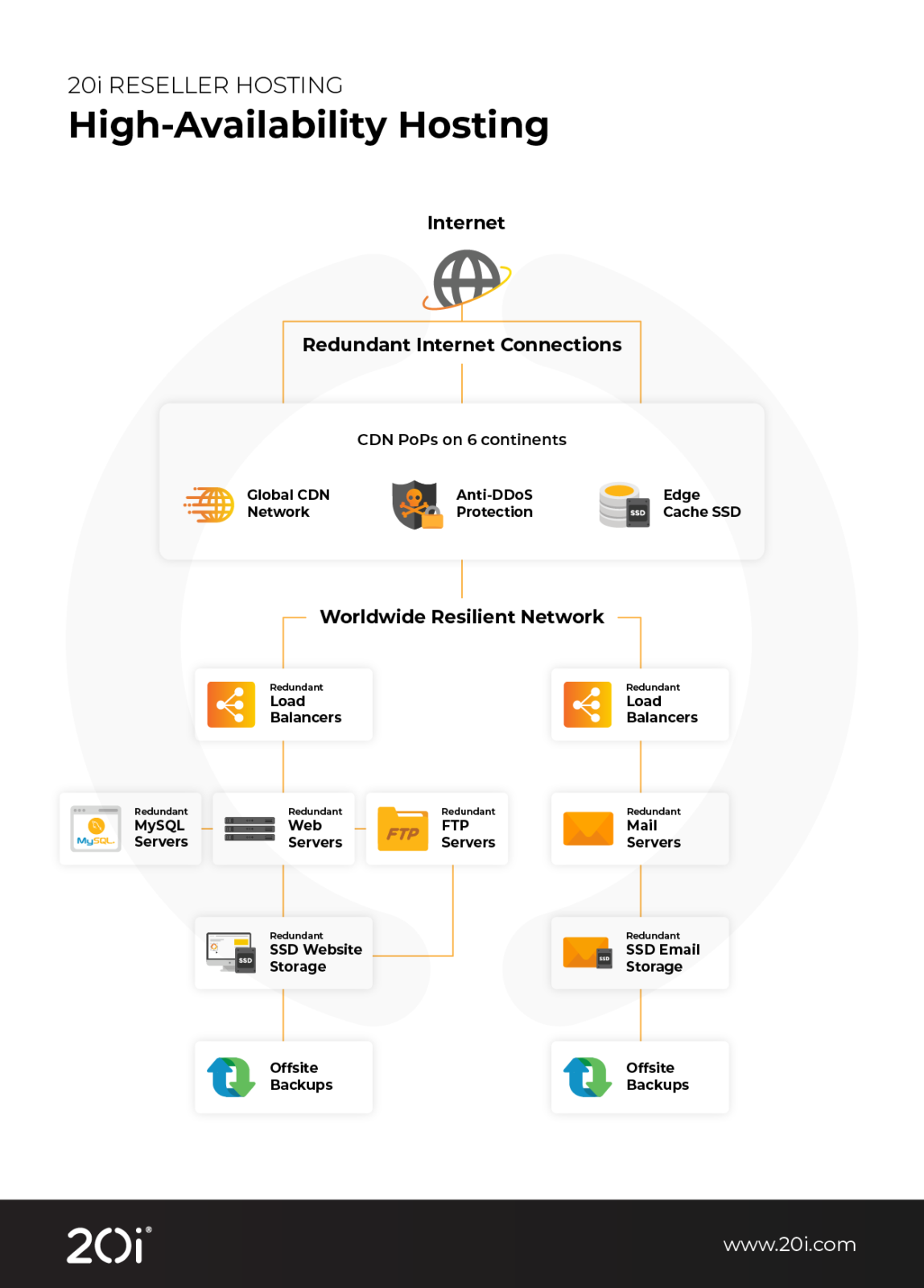
Credit: www.20i.com
What Is High Availability Hosting?
High Availability Hosting ensures that your website or application is always accessible, even during high traffic periods or unexpected failures. It’s a method of designing your hosting environment to minimize downtime and maintain performance. But what exactly is High Availability Hosting?
Key Features
High Availability Hosting comes with several key features that ensure continuous performance and reliability. These features work together to provide a seamless experience for users.
- Load Balancing: Distributes traffic across multiple servers, ensuring no single server is overwhelmed.
- Failover Systems: Automatically switches to a backup system if the primary one fails.
- Server Clustering: Connects multiple servers to work as a single unit, providing redundancy and improving performance.
- Disaster Recovery: Includes plans and systems to recover data and services quickly in case of a failure.
- Redundancy: Ensures that critical components have backups, so the system continues to function even if one part fails.
These features are essential for maintaining uptime and ensuring that your website or application remains accessible at all times. The combination of these elements provides a robust framework for high availability.
Importance In Business
High Availability Hosting is crucial for businesses that rely on their online presence. Here are some reasons why:
- Performance Optimization: Ensures that your website or application runs smoothly, enhancing user experience.
- Data Integrity: Protects your data from loss or corruption, ensuring that information is always accurate and available.
- Network Reliability: Maintains consistent access to your services, preventing disruptions that could affect your business operations.
Businesses that use Cloud Hosting benefit from scalable resources and network reliability. This ensures that they can handle varying traffic loads without compromising performance.
With High Availability Hosting, companies can focus on growth without worrying about downtime. The integration of failover systems and disaster recovery plans provides peace of mind, knowing that operations will continue even in the face of unexpected issues.
Investing in High Availability Hosting means prioritizing uptime and reliability, which are essential for maintaining customer trust and satisfaction. This approach helps businesses stay competitive and responsive to market demands.
Benefits Of High Availability
High Availability Hosting ensures that your website or application is always accessible, even during peak traffic times or server failures. The benefits of high availability are numerous, providing peace of mind and reliability for businesses and users alike. Let’s explore some key advantages.
Minimized Downtime
One of the main benefits of High Availability Hosting is minimized downtime. Downtime can severely impact user experience and business operations. High availability solutions like server replication and redundant systems ensure that your website remains online even during unexpected failures.
Here’s how it works:
- Server Replication: Data is copied in real-time across multiple servers. If one server fails, another takes over immediately.
- Redundant Systems: Multiple systems run in parallel. If one goes down, others continue to operate without interruption.
- Disaster Recovery: Plans and tools are in place to quickly restore services after a failure.
Consider this table showcasing downtime impacts:
| Downtime Duration | Impact |
|---|---|
| 1 minute | Minimal, slight user inconvenience |
| 1 hour | Significant user frustration, potential revenue loss |
| 1 day | Severe business disruption, major revenue loss |
By minimizing downtime, High Availability Hosting helps ensure continuous availability and maintains your business’s reputation.
Improved Performance
High Availability Hosting also leads to improved performance. This is achieved through techniques like load balancing and scalability. Load balancing distributes traffic across multiple servers, preventing any single server from becoming overwhelmed.
Benefits include:
- Load Balancing: Enhances performance by distributing user requests evenly across servers.
- Scalability: Easily add or remove resources to handle varying traffic loads.
- Cloud Hosting: Provides flexible resources, ensuring optimal performance during peak times.
Managed Hosting services often come with uptime guarantees, assuring businesses of reliable performance. Additionally, fault tolerance mechanisms help maintain performance by automatically handling errors or failures without affecting the end-user.
Here’s a quick comparison of traditional hosting vs. High Availability Hosting:
| Feature | Traditional Hosting | High Availability Hosting |
|---|---|---|
| Uptime Guarantee | Lower, often 99% | Higher, often 99.99% |
| Performance | Can degrade during high traffic | Consistently high, even during peak times |
| Scalability | Limited, requires manual intervention | High, automatic resource adjustment |
Investing in High Availability Hosting ensures your website performs well, keeping users satisfied and engaged.
Common Architectures
High Availability Hosting ensures that your website or application remains operational with minimal downtime. Common architectures in High Availability Hosting are designed to handle failures and provide continuous service. This article explores some of the common architectures used in High Availability Hosting.
Load Balancing
Load balancing is a critical component of High Availability Hosting. It distributes incoming traffic across multiple servers to ensure no single server becomes overwhelmed. This method enhances both performance optimization and network reliability. Here are some key points about load balancing:
- Performance Optimization: By spreading the load, servers can handle requests more efficiently.
- Redundant Servers: If one server fails, others can take over, ensuring continuous service.
- Scalable Infrastructure: Easily add or remove servers based on the traffic load.
Load balancing can be implemented using various techniques:
| Technique | Description |
|---|---|
| Round Robin | Distributes requests in a circular order. |
| Least Connections | Directs traffic to the server with the fewest active connections. |
| IP Hash | Uses the client’s IP address to determine which server will handle the request. |
Load balancing is essential for maintaining a high uptime guarantee. It also plays a vital role in disaster recovery by ensuring failover systems are in place.
Clustering Techniques
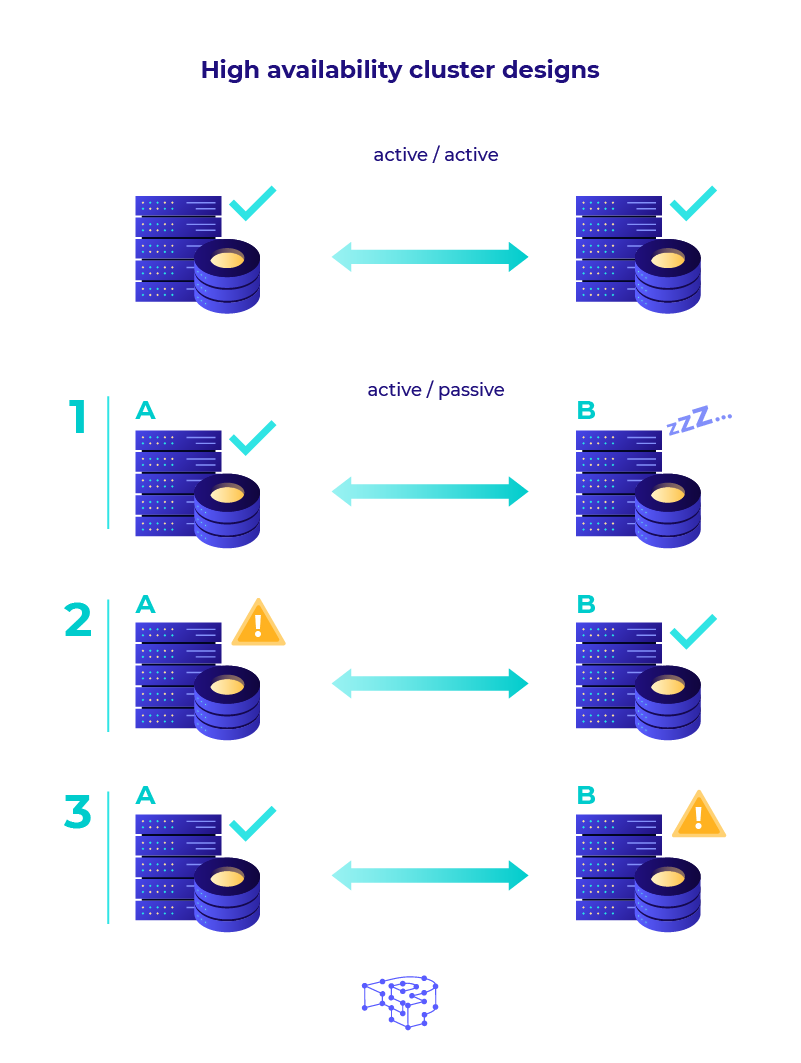
Clustering techniques involve using multiple servers to work together as a single system. This setup improves data replication and overall system reliability. In High Availability Hosting, clusters are crucial for several reasons:
- Data Replication: Ensures data consistency across all nodes in the cluster.
- Disaster Recovery: In case of a failure, another server in the cluster can take over.
- Network Reliability: Provides a robust and resilient infrastructure.
Different clustering techniques include:
- Active-Active Clustering: All nodes actively handle traffic, providing high performance and reliability.
- Active-Passive Clustering: One node is active while the others are on standby, ready to take over if the active node fails.
- Geographical Clustering: Servers are located in different geographical locations, offering better disaster recovery and performance optimization.
Clustering techniques are fundamental in cloud hosting environments. They support a scalable infrastructure that can grow with your needs. Clustering also enhances the uptime guarantee by minimizing the risk of a single point of failure.
Both load balancing and clustering techniques are essential for achieving high availability. They ensure your services remain accessible and reliable, even in the face of hardware or software failures.

Credit: www.accuwebhosting.com
Choosing A Provider
Choosing the right provider for High Availability Hosting is crucial. It ensures your website remains online and performs well. To make an informed decision, consider evaluating reliability, support, and scalability. This guide will help you understand key factors for each aspect.
Evaluating Reliability
Reliability is the backbone of High Availability Hosting. A reliable provider minimizes downtime and maintains consistent performance.
Look for the following indicators of reliability:
- Uptime Guarantee: Ensure the provider offers at least a 99.9% uptime guarantee.
- Redundant Systems: Multiple data centers and redundant hardware reduce the risk of failure.
- Failover Solutions: Automatic failover systems quickly switch to backup servers if one fails.
- Disaster Recovery: A robust disaster recovery plan ensures data integrity during unforeseen events.
Additionally, consider the provider’s performance optimization strategies. Efficient load balancing distributes traffic across multiple servers, enhancing speed and reducing the risk of overload. A table can help you compare different providers:
| Provider | Uptime Guarantee | Redundant Systems | Failover Solutions | Disaster Recovery |
|---|---|---|---|---|
| Provider A | 99.9% | Yes | Yes | Yes |
| Provider B | 99.95% | Yes | No | Yes |
| Provider C | 99.99% | No | Yes | No |
Support And Scalability
Support and scalability are vital for long-term success. Reliable support ensures quick resolution of issues. Scalability allows your hosting to grow with your needs.
Consider the following for support:
- 24/7 Support: Round-the-clock support is essential for resolving urgent issues.
- Knowledgeable Staff: Ensure the support team has expertise in high availability hosting.
- Multiple Channels: Availability of support through chat, email, and phone adds convenience.
For scalability, assess these factors:
- Scalable Infrastructure: The provider should offer scalable resources to handle traffic spikes.
- Cloud Hosting: Cloud hosting solutions provide flexibility and easy scalability.
- Server Clustering: Clustering multiple servers can improve performance and reliability.
A table comparing support and scalability features can be useful:
| Provider | 24/7 Support | Knowledgeable Staff | Scalable Infrastructure | Cloud Hosting | Server Clustering |
|---|---|---|---|---|---|
| Provider A | Yes | Yes | Yes | Yes | No |
| Provider B | Yes | No | No | Yes | Yes |
| Provider C | No | Yes | Yes | No | Yes |
Implementing High Availability
High Availability Hosting ensures that your website or application remains accessible and performs efficiently, even during high traffic periods or hardware failures. Implementing High Availability involves various strategies and tools to minimize downtime and maintain seamless operations. Let’s explore some best practices and monitoring tools to achieve high availability.
Best Practices
Implementing High Availability requires a combination of strategies and technologies. Here are some essential best practices:
- Redundant Systems: Use multiple servers to ensure your system remains operational if one server fails. Redundant systems provide backup and improve reliability.
- Load Balancing: Distribute traffic across multiple servers to avoid overloading any single server. Load balancing helps maintain performance optimization.
- Server Replication: Duplicate your data and applications across different servers. Server replication ensures data availability and integrity.
- Data Backup Solutions: Regularly back up your data to prevent data loss in case of hardware failure or cyber-attacks. Use both local and cloud hosting backups for added security.
- Network Resilience: Implement robust network infrastructures. Use multiple network paths to ensure continuous connectivity and avoid single points of failure.
- Failover Solutions: Set up automatic failover mechanisms to switch to backup systems during failures. Failover solutions minimize downtime and keep services running.
- Disaster Recovery: Develop a disaster recovery plan. Test it regularly to ensure quick recovery from catastrophic events.
These best practices help you achieve an uptime guarantee, keeping your services available to users at all times.
Monitoring Tools
Effective monitoring tools are crucial for maintaining high availability. They help detect issues early and provide insights for proactive management. Here are some essential monitoring tools:
- Performance Monitoring: Tools like New Relic or AppDynamics monitor application performance. They track response times, error rates, and resource usage.
- Network Monitoring: Tools such as Nagios or SolarWinds monitor network health. They detect outages and performance bottlenecks in real-time.
- Server Monitoring: Tools like Zabbix or Datadog provide comprehensive server health checks. They monitor CPU usage, memory, disk space, and more.
- Log Management: Tools such as Splunk or ELK Stack collect and analyze logs. They help identify issues and trends by examining log data.
- Cloud Monitoring: Tools like AWS CloudWatch or Azure Monitor provide insights into cloud hosting environments. They track resource utilization and performance metrics.
Using these monitoring tools allows you to detect and address issues swiftly, ensuring continuous availability and performance optimization.
Challenges To Consider
High Availability Hosting ensures that your website or application is accessible at all times, even during hardware failures or peak traffic. This setup is crucial for businesses that require constant uptime and reliable performance. Yet, achieving High Availability comes with its own set of challenges. Below, we will explore some of these challenges.
Cost Implications
High Availability Hosting can be expensive. The costs involve not just the hardware, but also the software and human resources needed to maintain the system. Here are some key cost factors:
- Redundant Systems: To ensure uptime guarantees, you need multiple servers and backup systems. This redundancy adds to the overall cost.
- Load Balancing: Proper load balancing is crucial for performance optimization. High-quality load balancers can be costly but are necessary for distributing traffic evenly across servers.
- Cloud Hosting: Cloud solutions often provide better scalability and failover solutions but come at a higher price point compared to traditional hosting.
- Disaster Recovery: Investing in a robust disaster recovery plan is essential. This includes off-site backups and real-time data replication, which can be expensive.
Here is a table summarizing the cost implications:
| Component | Cost Range | Reason |
|---|---|---|
| Redundant Systems | $500-$5000/month | Ensures uptime and reliability |
| Load Balancing | $200-$2000/month | Optimizes performance |
| Cloud Hosting | $1000-$10,000/month | Offers scalability and failover solutions |
| Disaster Recovery | $500-$5000/month | Ensures data safety and recovery |
Complexity Of Setup
Setting up High Availability Hosting is complex. It requires careful planning and execution. Here are some aspects to consider:
- Server Reliability: Choosing reliable servers is the first step. Not all servers are built for high availability.
- Scalability: The system must be scalable to handle varying loads. This involves configuring hardware and software to work seamlessly together.
- Performance Optimization: Ensuring that all components work efficiently is challenging. This may involve tuning databases, optimizing code, and setting up caching mechanisms.
- Failover Solutions: Implementing failover solutions is crucial. This involves setting up automatic switchovers to backup systems in case of failure.
- Redundant Systems: Maintaining multiple systems requires constant monitoring and updates. This ensures that all systems are up-to-date and functioning correctly.
Below is a simple checklist for setting up High Availability Hosting:
| Task | Description | Priority |
|---|---|---|
| Choose Reliable Servers | Select servers designed for high availability | High |
| Configure Load Balancing | Set up load balancers to distribute traffic | High |
| Implement Failover Solutions | Set up automatic failover mechanisms | Medium |
| Optimize Performance | Optimize all components for better performance | Medium |
| Ensure Scalability | Make sure the system can scale as needed | Low |
In summary, the setup process involves many steps and requires expertise. The complexity can be overwhelming, but with careful planning, you can achieve a highly available system.
Future Trends
High Availability Hosting ensures that websites and applications remain operational, even during hardware failures or unexpected surges in traffic. As technology evolves, understanding future trends becomes crucial to stay ahead. These trends focus on enhancing performance, reliability, and efficiency. Let’s explore some key future trends.
Cloud Integration
Cloud integration is becoming essential for High Availability Hosting. With the growing reliance on cloud hosting, businesses benefit from scalable infrastructure and enhanced uptime.
Key benefits of cloud integration include:
- Scalable Infrastructure: Easily adjust resources to meet demand.
- Redundancy: Multiple data centers ensure data is always available.
- Load Balancing: Distribute traffic to prevent any single point of failure.
These benefits are crucial for maintaining high availability. A table below highlights the advantages:
| Feature | Benefit |
|---|---|
| Scalable Infrastructure | Adjust resources based on demand |
| Redundancy | Data available across multiple centers |
| Load Balancing | Prevent single point of failure |
Cloud integration also supports failover solutions. These solutions automatically switch to a standby server if the primary one fails, ensuring continuous uptime. This integration enhances disaster recovery plans, making data recovery faster and more reliable.
Ai And Automation
AI and Automation are transforming High Availability Hosting by improving performance optimization and reducing manual intervention.
Key areas where AI and Automation make an impact include:
- Performance Optimization: AI analyzes data to optimize server performance.
- Failover Solutions: Automated systems switch to backup servers instantly.
- Managed Hosting: Automation reduces the need for manual management.
These advances ensure smoother operations. A table below illustrates the impact:
| Feature | Impact |
|---|---|
| Performance Optimization | Improved server efficiency |
| Failover Solutions | Instant server switchover |
| Managed Hosting | Less manual management |
AI also aids in proactive monitoring. It predicts potential issues and addresses them before they affect uptime. Automation ensures that redundancy protocols are followed without human intervention, thus enhancing reliability.
Credit: pressidium.com
Frequently Asked Questions
What Is High Availability Hosting?
High availability hosting ensures your website is always accessible. It uses multiple servers to reduce downtime. This setup enhances reliability and performance.
Why Is High Availability Hosting Important?
High availability hosting minimizes downtime, ensuring your site is always online. It improves user experience and boosts your site’s credibility.
How Does High Availability Hosting Work?
High availability hosting uses redundant servers. If one server fails, others take over. This ensures continuous operation without interruptions.
What Are The Benefits Of High Availability Hosting?
Benefits include improved uptime, better performance, and increased reliability. It also helps in handling traffic spikes effectively.
Conclusion
High availability hosting ensures your website is always online. It boosts reliability and performance. This makes your users happy. Investing in high availability hosting reduces downtime. It protects your brand reputation. Choose a reliable hosting provider. Your business will thrive.
Your users will thank you.