

Algorithmic trading software has transformed the financial markets. It uses computer programs to trade securities at speeds and frequencies impossible for humans.
This software offers many benefits for traders. It helps in making quick decisions based on data. By using complex algorithms, it can analyze large amounts of information swiftly. This reduces errors that humans might make. It also operates continuously without getting tired, ensuring trades are executed at the best times.
For those looking to streamline their trading activities, this software can be a valuable tool. It can enhance efficiency, accuracy, and profitability. With the rise of technology, understanding these benefits is crucial for anyone involved in trading. Dive in to learn why algorithmic trading software might be the edge you need.

Credit: www.velvetech.com
Speed And Efficiency
Algorithmic trading software is transforming the financial world. One of the major benefits is its speed and efficiency. These systems can execute trades faster than any human could. They use complex algorithms to analyze markets and make decisions in fractions of a second. This speed and efficiency give traders a significant advantage in the fast-paced world of financial markets.
Rapid Execution
Rapid execution is one of the key benefits of algorithmic trading software. These systems can carry out trades at lightning speed, much faster than a human trader. This is crucial because in trading, every second counts. Here are some of the reasons why:
-
Execution Speed: Automated trading systems can analyze and execute trades in milliseconds.
-
Market Analysis Software: These systems use advanced algorithms to analyze market data in real-time.
-
Trading Strategies: They can execute complex trading strategies quickly and efficiently.
Consider the following table to understand the difference in speed:
|
Manual Trading |
Algorithmic Trading |
|---|---|
|
Seconds to Minutes |
Milliseconds |
This speed allows traders to capitalize on even the smallest market movements. By the time a human trader reacts, the opportunity might be gone. With algorithmic trading, the trade is already executed. This rapid execution leads to better trading efficiency and increased profitability.
Reduced Human Error
Another major advantage is the reduced human error. Human traders can make mistakes, especially under stress. Algorithmic trading software eliminates many of these errors. Here’s how:
-
Automated Trading Systems: These systems follow predefined rules and strategies without deviation.
-
Trading Algorithms: Algorithms do not suffer from emotions like fear or greed, leading to more rational decisions.
-
Quantitative Trading Solutions: They rely on data and statistical analysis, reducing the chances of error.
Let’s break this down further:
-
Consistency: Automated systems are consistent. They perform the same analysis and execute trades in the same way every time.
-
Risk Management Tools: These tools help in managing and mitigating risks more effectively than a human could.
-
Financial Trading Automation: Automation reduces the need for human intervention, thus minimizing errors.
Reduced human error leads to better performance and higher trading efficiency. Traders can rely on these systems to execute their strategies accurately and consistently. This reliability is one of the key algorithmic trading advantages.
Data Analysis Power
Algorithmic Trading Software has transformed the landscape of financial markets. One of its greatest strengths lies in its data analysis power. This capability allows traders to make informed decisions based on vast amounts of data. By leveraging powerful algorithms and computational techniques, traders can gain insights that were previously unattainable.
Big Data Insights
Algorithmic trading software excels in handling large datasets. This is known as big data insights. Traders can analyze extensive historical data to identify patterns and trends. This process, called quantitative analysis, is essential for developing effective trading strategies.
With big data insights, traders can:
-
Identify market trends
-
Predict price movements
-
Optimize trading strategies
-
Improve risk management
For instance, consider a table that shows how big data insights impact various aspects of trading:
|
Aspect |
Impact |
|---|---|
|
Market Efficiency |
Improved through data analysis |
|
Trading Strategies |
Enhanced by identifying trends |
|
Risk Management |
Better through predictive analysis |
|
Performance Optimization |
Achieved by refining strategies |
By leveraging big data insights, traders can make data-driven decision making a central part of their approach. This leads to more effective and efficient trading in the complex world of financial markets.
Real-time Analytics
Another critical component of algorithmic trading software is real-time analytics. This feature allows traders to analyze data as it is generated. This capability is crucial for high-frequency trading and other fast-paced trading environments.
Real-time analytics provide several benefits:
-
Immediate reaction to market changes
-
Accurate execution of trading strategies
-
Enhanced performance optimization
-
Improved risk management
Consider the following table that illustrates the advantages of real-time analytics:
|
Advantage |
Explanation |
|---|---|
|
Immediate Reaction |
Traders can act on new data instantly |
|
Accurate Execution |
Minimizes delays in trade execution |
|
Performance Optimization |
Continuously refines strategies |
|
Risk Management |
Quickly addresses potential risks |
Real-time analytics enable traders to stay ahead in the market. By integrating this feature into automated trading systems, they can achieve superior results. This ensures that their trading strategies are always aligned with current market conditions.
Backtesting Capabilities
Algorithmic trading software offers many advantages for traders. One of the most important is the ability to backtest trading strategies. Backtesting allows traders to test their financial algorithms on historical data before using them in live markets. This process helps in fine-tuning trading strategies, improving risk management, and understanding potential trading performance. Let’s explore the backtesting capabilities in more detail.
Simulated Trading
Simulated trading is a key feature of backtesting. It allows traders to execute trades on historical data as if they were happening in real-time. This helps in assessing how well a trading strategy performs under various market conditions without any financial risk. Here are some benefits of simulated trading:
-
Realistic Experience: Traders can see how their algorithms execute trades in a controlled environment.
-
Execution Speed: Simulated trading helps in understanding the speed at which trades are executed, which is crucial for high-frequency trading.
-
Risk-Free: It allows for the testing of new strategies without risking actual capital.
Simulated trading provides valuable insights into how a trading strategy would perform under different market conditions. This helps in identifying any potential issues with the strategy and making necessary adjustments.
|
Feature |
Benefits |
|---|---|
|
Realistic Experience |
Understand the practical execution of trades. |
|
Execution Speed |
Assess the speed of trade execution. |
|
Risk-Free Testing |
Test strategies without financial loss. |
Strategy Validation
Validating a trading strategy is essential to ensure it works as expected. Backtesting provides a platform for strategy validation, helping traders refine their approaches. Here are some steps involved in strategy validation:
-
Data Collection: Gather historical market data for analysis.
-
Algorithm Development: Create the financial algorithms based on trading strategies.
-
Backtesting: Test the algorithms on the collected data.
-
Performance Analysis: Evaluate the trading performance to identify strengths and weaknesses.
Backtesting helps in identifying the most effective trading strategies. It allows traders to make data-driven decisions based on past market analysis. This results in better risk management and improved trading performance.
By validating strategies through backtesting, traders can optimize their automated trading systems. This ensures that the trading software performs effectively in live market conditions. Proper validation also helps in minimizing potential losses and maximizing gains.
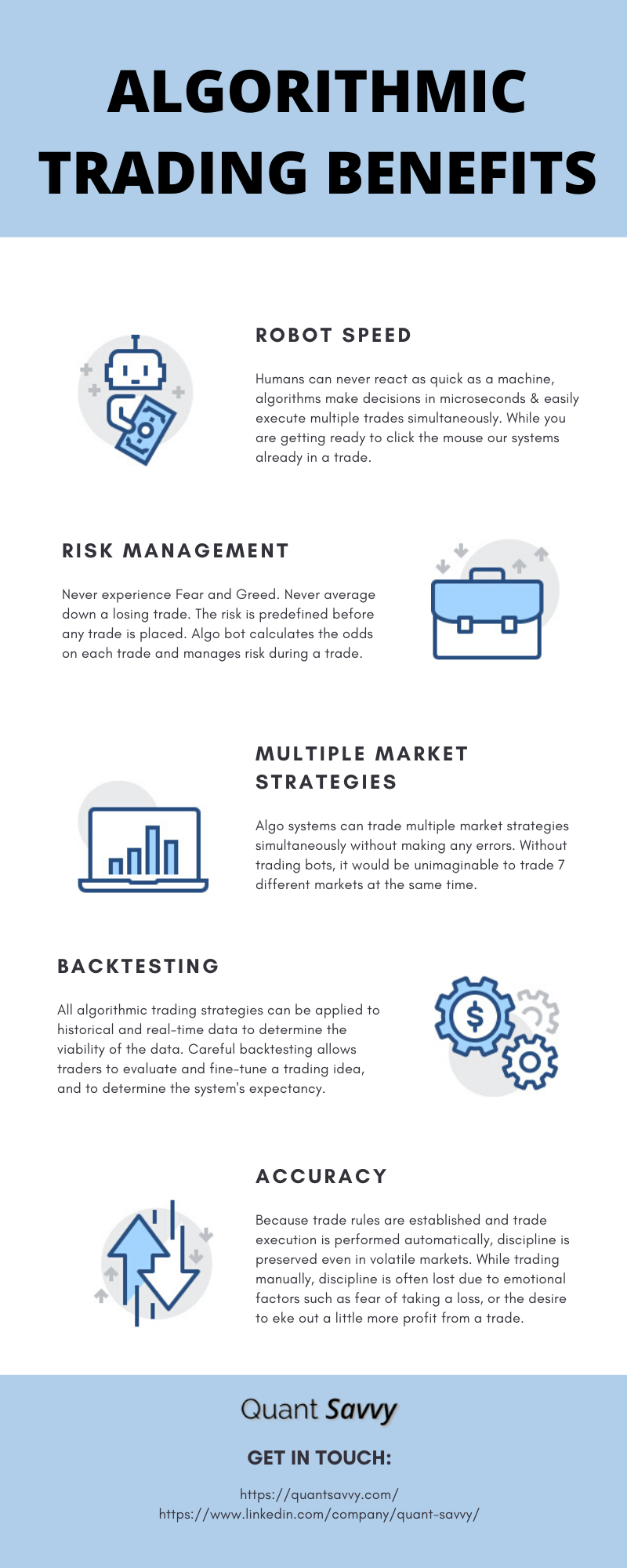
Credit: quantsavvy.com
Cost Reduction
Algorithmic trading software offers numerous benefits, with cost reduction being a significant advantage. By automating trading processes, this software can effectively reduce costs associated with manual trading. Let’s delve into how algorithmic trading software achieves cost reduction through lower transaction costs and minimized operational expenses.
Lower Transaction Costs
Algorithmic trading software significantly lowers transaction costs. Manual trading often involves high fees due to human intervention. Automated trading reduces these costs by executing trades faster and more efficiently. Here are some ways it achieves this:
-
Reduced Brokerage Fees: Automated trading can perform high-frequency trades, often at lower brokerage fees compared to manual trading.
-
Lower Market Impact: Smaller, algorithmically executed trades have a lower market impact, which helps in achieving better prices and reduced costs.
Consider the example below to understand the difference in transaction costs:
|
Manual Trading |
Algorithmic Trading |
|---|---|
|
$10 per trade |
$1 per trade |
|
High slippage cost |
Low slippage cost |
|
Delayed execution |
Instant execution |
By reducing transaction costs, investors can save significant amounts over time, leading to better overall returns on investment.
Minimized Operational Expenses
In addition to lowering transaction costs, algorithmic trading software helps minimize operational expenses. Manual trading requires substantial human resources, infrastructure, and time. Automated trading streamlines these processes, leading to considerable savings. Here’s how:
-
Reduced Staffing Costs: Automated systems do not need extensive teams for executing trades, thus reducing personnel expenses.
-
Lower Infrastructure Costs: Trading software requires less physical space and resources compared to traditional trading setups.
-
Efficient Market Analysis: The software conducts market analysis swiftly, reducing the need for extensive research teams.
The table below highlights the cost differences:
|
Expense Type |
Manual Trading |
Algorithmic Trading |
|---|---|---|
|
Staffing Costs |
$100,000/year |
$20,000/year |
|
Infrastructure Costs |
$50,000/year |
$10,000/year |
|
Research Costs |
$30,000/year |
$5,000/year |
Minimized operational expenses contribute to higher profitability. Algorithmic trading software offers a cost-effective solution for managing investments, making it an attractive option for traders in financial markets.
Emotion-free Trading
Algorithmic trading software has transformed the way traders operate in financial markets. One major advantage is emotion-free trading. Emotions often cloud judgment, leading to poor decisions and financial losses. Algorithmic trading eliminates this risk by relying on data and automated trading strategies, ensuring more accurate and efficient trades.
Avoiding Bias
Human traders are prone to biases that can adversely affect their trading decisions. Algorithmic trading software helps in avoiding bias by making decisions based on data and pre-set rules. Here are some common biases that traders face:
-
Confirmation Bias: Traders favor information that confirms their preconceptions.
-
Loss Aversion: Traders fear losses more than they value gains.
-
Overconfidence: Traders overestimate their knowledge or predictive power.
By using trading algorithms, these biases are eliminated. The software makes decisions based on historical data and predefined trading strategies. This ensures that trades are executed without emotional interference.
Consider the following comparison:
|
Human Trader |
Algorithmic Trading Software |
|---|---|
|
Prone to emotional decisions |
Relies on data and rules |
|
Biases affect judgment |
Bias-free execution |
|
Inconsistent performance |
Consistent execution |
In summary, algorithmic trading software ensures that decisions are made logically and systematically, reducing the risk of emotional and biased trading.
Consistent Decision Making
One of the primary benefits of algorithmic trading is consistent decision making. Human traders can be inconsistent due to fatigue, emotions, or external factors. Automated trading software ensures consistency by following set rules and algorithms.
Here are some advantages of consistent decision making:
-
Execution Speed: Algorithms can execute trades faster than humans.
-
Market Analysis: Continuous analysis without breaks or errors.
-
Risk Management: Systematic implementation of risk management strategies.
Using trading software, traders can implement quantitative trading strategies that are tested and refined over time. This leads to more predictable and reliable results. The trading algorithms monitor financial markets continuously, ensuring that opportunities are seized without delay.
Consistent decision making is crucial for effective risk management. By automating trades, the software adheres to predefined risk parameters, minimizing potential losses.
Here’s a quick comparison:
|
Human Trader |
Algorithmic Trading Software |
|---|---|
|
Inconsistent trade execution |
Consistent trade execution |
|
Subject to emotions and fatigue |
Emotion-free and tireless |
|
Variable risk management |
Systematic risk management |
Algorithmic trading software enhances trading performance by ensuring consistent and unbiased decision making, leading to more efficient and profitable trading outcomes.
Market Opportunities
Algorithmic trading software offers a wealth of market opportunities for traders. This advanced technology allows users to take advantage of market inefficiencies and execute trades with precision. The benefits extend beyond just profit potential; they include access to diverse markets and the ability to trade around the clock. Let’s explore these advantages in detail.
Access To Diverse Markets
Algorithmic trading software provides traders with unprecedented access to diverse markets. This enables the execution of investment strategies across various financial markets. Here are some key points:
-
Global Reach: Traders can access stock markets, forex, commodities, and more across the globe.
-
Diverse Instruments: Use trading algorithms to trade stocks, bonds, options, and futures efficiently.
-
Market Access: Gain entry to emerging markets that are often difficult to reach manually.
Automated trading systems make it easier to diversify portfolios. This reduces risk and enhances potential returns. Below is a table summarizing the types of markets accessible through algorithmic trading software:
|
Market Type |
Examples |
|---|---|
|
Stocks |
NYSE, NASDAQ, LSE |
|
Forex |
EUR/USD, GBP/JPY |
|
Commodities |
Gold, Oil, Silver |
|
Options |
Call, Put |
|
Futures |
Indices, Interest Rates |
24/7 Trading Potential
One significant benefit of algorithmic trading software is the ability to trade 24/7. This feature is crucial for markets like forex and cryptocurrencies, which operate non-stop. Key advantages include:
-
Continuous Market Monitoring: Trading algorithms can monitor markets at all times, identifying profitable opportunities.
-
Reduced Human Intervention: Automated trading systems execute trades without the need for manual input, enhancing trading efficiency.
-
Risk Management: Algorithms can quickly respond to market changes, implementing risk management strategies to protect investments.
This constant market engagement allows traders to maximize opportunities and minimize losses. The table below highlights markets that benefit from 24/7 trading capabilities:
|
Market Type |
Trading Hours |
|---|---|
|
Forex |
24/7 |
|
Cryptocurrencies |
24/7 |
|
Commodities |
Extended hours |
|
Futures |
Varies |
By leveraging quantitative trading and automated systems, traders can capitalize on market opportunities at any time. This results in more efficient trading and better alignment with global market activities.
Customization Flexibility
Algorithmic Trading Software offers numerous benefits, with Customization Flexibility being a standout feature. This flexibility allows traders to tailor their trading systems to fit specific needs and preferences. This ensures improved trading strategy optimization and better investment performance. With customization, traders gain the ability to develop tailored strategies and personalized alerts that match their unique trading goals.
Tailored Strategies
One of the primary advantages of algorithmic trading software is the ability to create tailored strategies. This customization enables traders to design algorithms that suit their unique trading styles and risk tolerance levels. Here’s how tailored strategies can be beneficial:
-
Trading Strategy Optimization: Traders can optimize strategies based on real-time data analysis. This ensures the best possible trade execution efficiency.
-
Risk Management Tools: Custom strategies allow for the integration of advanced risk management tools. This helps in mitigating potential losses.
-
Quantitative Trading: By utilizing quantitative trading techniques, traders can develop strategies based on mathematical models. This ensures consistency and accuracy in trading.
Below is a table summarizing the benefits of tailored strategies:
|
Benefit |
Description |
|---|---|
|
Trading Strategy Optimization |
Improves trade execution efficiency and investment performance. |
|
Risk Management Tools |
Helps in mitigating potential losses with advanced tools. |
|
Quantitative Trading |
Ensures consistent and accurate trading using mathematical models. |
Customizing trading strategies according to specific needs ensures better alignment with market conditions. This leads to more effective financial market analysis and improved trading outcomes.
Personalized Alerts
Personalized alerts are another significant benefit of algorithmic trading software. These alerts help traders stay informed about crucial market movements and trading opportunities. Here’s how personalized alerts can enhance trading efficiency:
-
Real-Time Data Analysis: Alerts are based on real-time data, ensuring timely notifications of significant market changes.
-
Automated Trading Systems: Automated systems can send alerts for specific trading conditions. This reduces the need for constant market monitoring.
-
Improved Trade Execution: Personalized alerts ensure that traders can execute trades quickly, taking advantage of market opportunities.
Below is a list of common types of personalized alerts:
-
Price Alerts: Notifications when a security reaches a specific price point.
-
Volume Alerts: Alerts based on unusual trading volumes.
-
News Alerts: Updates on relevant news affecting specific securities.
These alerts ensure that traders remain informed and can make timely decisions. This results in better trading outcomes and enhanced trade execution efficiency. Personalized alerts are crucial for maintaining an edge in the fast-paced trading environment.
Risk Management Tools
Algorithmic trading software offers numerous benefits, especially in the area of risk management. Risk management tools are essential for traders to protect their investments and minimize potential losses. These tools help traders make informed decisions and automate crucial aspects of their trading strategies. Two key features of algorithmic trading software for risk management are Automated Stop-Loss and Diversification Strategies.
Automated Stop-loss
Automated Stop-Loss is a vital risk management tool within algorithmic trading software. It helps traders set predefined exit points to limit potential losses. This feature automatically executes a trade when the market reaches a certain price level. Here are some key benefits:
-
Prevention of Emotional Trading: Automated Stop-Loss removes emotions from trading decisions. It ensures trades are executed based on predefined criteria.
-
Consistent Risk Management: By setting stop-loss levels, traders can consistently manage risk across all trades. This consistency helps in maintaining a disciplined approach.
-
Protection Against Market Volatility: Automated Stop-Loss protects traders from unexpected market movements. It ensures that losses are capped at a certain level.
Consider the following table for a better understanding:
|
Stop-Loss Level |
Potential Loss |
Market Condition |
|---|---|---|
|
2% |
$200 |
Stable |
|
5% |
$500 |
Volatile |
|
10% |
$1000 |
Highly Volatile |
Automated Stop-Loss is an essential feature for traders who want to manage their risks effectively. It ensures that trades are executed precisely and losses are kept within acceptable limits.
Diversification Strategies
Diversification Strategies are another crucial aspect of risk management in algorithmic trading software. Portfolio diversification helps spread risk across various assets and markets. This reduces the impact of a poor-performing asset on the overall portfolio. Here are some benefits:
-
Reduced Risk Exposure: Diversification minimizes the risk of significant losses by spreading investments across different assets.
-
Enhanced Market Analysis: Algorithmic trading software can analyze multiple markets simultaneously. This allows for better diversification opportunities.
-
Improved Execution Speed: Automated trading systems execute trades quickly. This ensures that diversification strategies are implemented efficiently.
Here is an example of a diversified portfolio:
|
Asset Class |
Percentage Allocation |
|---|---|
|
Stocks |
40% |
|
Bonds |
30% |
|
Commodities |
20% |
|
Cryptocurrencies |
10% |
Diversification strategies in algorithmic trading not only help in risk management but also provide opportunities for better returns. By leveraging algorithmic strategies and trading algorithms, traders can create well-diversified portfolios that are resilient to market fluctuations.

Credit: en.wikipedia.org
Frequently Asked Questions
What Is Algorithmic Trading Software?
Algorithmic trading software uses algorithms to execute trades automatically. It helps traders make faster, more accurate decisions.
How Does Algorithmic Trading Work?
Algorithmic trading uses mathematical models and algorithms. It automates trade decisions based on market data and pre-set criteria.
Why Use Algorithmic Trading Software?
Algorithmic trading software offers speed, accuracy, and efficiency. It reduces human error and allows for 24/7 trading.
What Are The Advantages Of Algorithmic Trading?
Advantages include faster trade execution, reduced errors, and backtesting capabilities. It also offers better risk management and consistency.
Conclusion
Algorithmic trading software offers many benefits. It can boost trading efficiency. Reduce human errors. Maximize opportunities in the market. Traders can react faster to market changes. It also helps in making data-driven decisions. This leads to better trading outcomes. Overall, using this software can improve your trading strategy.
It makes trading more accessible and effective. Consider integrating it into your trading routine. Enjoy the advantages it brings.