

Seeing lots of visitors on your website but no sales? This is a common issue many businesses face.
Having high website traffic is great. It shows people are interested in your site. But the real goal is to turn those visitors into customers. So, why aren’t they buying? Several factors can contribute to this problem. Maybe your website isn’t user-friendly.
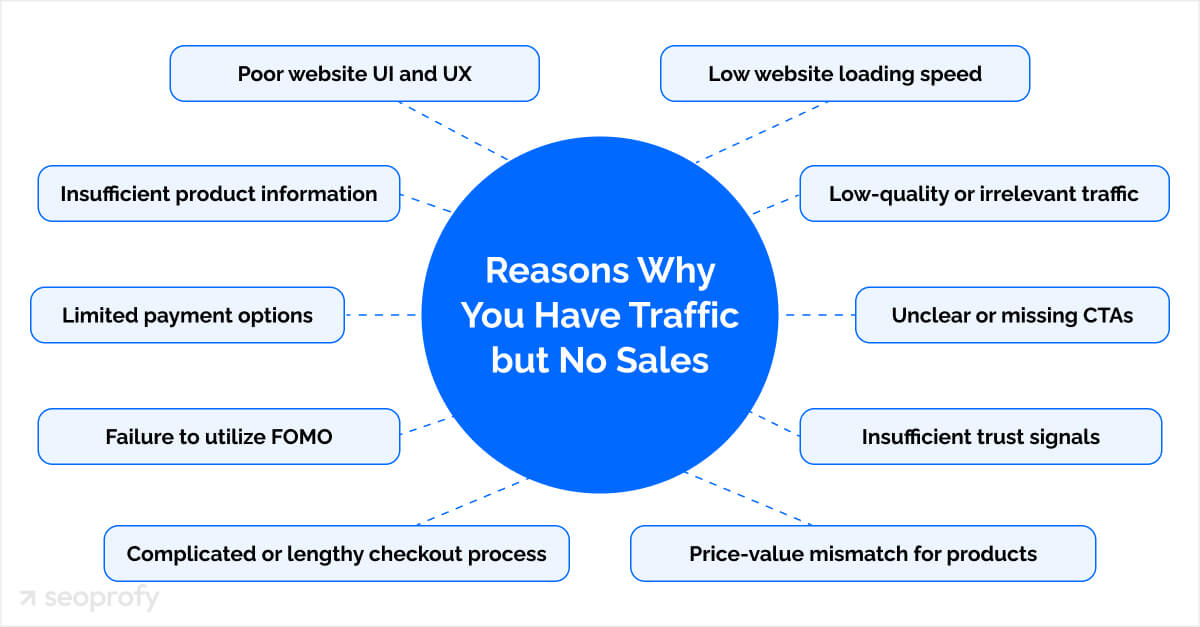
Perhaps your product descriptions aren’t clear. Or, your prices may seem too high. Understanding these issues is crucial for improving your sales. In this blog post, we will explore the main reasons behind this challenge. We’ll also offer practical tips to help you convert traffic into sales. Stay tuned to learn how to make your website more effective.
Credit: seoprofy.com
Reasons For High Traffic
Seeing high traffic on your website but no sales? This is a common issue many businesses face. Understanding the reasons for this disparity can help you make the necessary adjustments to convert those visitors into paying customers. Let’s explore some of the main reasons for high traffic.
Quality Of Traffic
Not all traffic is created equal. The quality of your website visitors plays a crucial role in your sales funnel. Here are some factors to consider:
- Targeted Audience: Are you attracting the right people? A high volume of traffic means nothing if these visitors are not interested in your product or service.
- User Experience: Is your website easy to navigate? If visitors find it hard to find what they are looking for, they will leave quickly, increasing your bounce rate.
- Customer Engagement: Are you engaging your audience effectively? Engaging content keeps visitors on your site longer, making them more likely to convert.
To improve the quality of traffic, you can:
- Analyze your website analytics to understand visitor behavior.
- Optimize your website for better user experience.
- Focus on creating valuable content that engages your audience.
Quality traffic is about attracting visitors who are genuinely interested in what you offer. This will lead to higher conversion rates and more sales.
Source Of Visitors
The source of your website visitors can significantly impact your conversion rates. Let’s break down some common sources:
| Source | Impact on Sales |
|---|---|
| Organic Traffic | Visitors from search engines are often looking for specific information. They have a higher intent to purchase. |
| Paid Advertising | Ads can drive a lot of traffic, but if not targeted well, it might not convert. Focus on targeting the right audience. |
| Social Media | Social media traffic is good for brand awareness. These visitors might not be ready to buy immediately. |
Understanding the source of your traffic can help you tailor your marketing strategy. For example:
- Organic Traffic: Invest in SEO to attract high-intent visitors.
- Paid Advertising: Use targeted ads to reach potential customers who are likely to convert.
- Social Media: Engage with your audience and drive traffic to specific landing pages designed for lead generation.
By focusing on the sources of your visitors, you can improve your conversion rates and turn high traffic into actual sales.

Credit: www.convertcart.com
User Experience Issues
Getting a lot of traffic on your website but no sales? You may be facing user experience issues. A poor user experience can drive potential customers away, affecting your conversion rate. Let’s delve into some common user experience issues and how they might be impacting your sales.
Website Design
Your website design plays a crucial role in user experience. A well-designed website can enhance user engagement and improve conversion rates. Here are some design aspects to consider:
- Responsive Design: Ensure your website looks good on all devices, including smartphones and tablets. A responsive design can reduce bounce rates and keep users engaged.
- Loading Speed: Slow loading times can frustrate users. Optimize images and use efficient coding practices to improve loading speed.
- Visual Appeal: Use a clean and visually appealing layout. Avoid clutter and ensure that your landing page design is inviting.
- Color Scheme: Choose a color scheme that aligns with your brand and is easy on the eyes. This can enhance the overall user experience.
| Design Aspect | Impact on User Experience |
|---|---|
| Responsive Design | Improves accessibility across devices |
| Loading Speed | Reduces bounce rate |
| Visual Appeal | Increases user engagement |
| Color Scheme | Enhances brand alignment |
Navigation Challenges
Navigation is another critical aspect of user experience. If users can’t find what they’re looking for, they’ll leave your site. Here are some common navigation issues and solutions:
- Complex Menus: Simplify your menu structure. Use clear and concise labels for menu items.
- Broken Links: Regularly check for and fix broken links. This prevents users from landing on error pages.
- Search Functionality: Implement a robust search feature. Ensure it returns relevant results quickly.
- Breadcrumbs: Use breadcrumbs to help users understand their current location on your site. This can improve the customer journey.
Effective navigation can guide users smoothly through your website. This leads them to your call to action buttons, improving your e-commerce strategies. By addressing these navigation challenges, you can enhance your website optimization efforts. This will ultimately lead to better user experience and higher conversion rates.
Content Relevance
Many websites face the issue of high traffic but low sales. One key reason is content relevance. If your content does not align with what your visitors want, they will leave without making a purchase. Ensuring your content is relevant can significantly improve your sales.
Target Audience
To make your content relevant, you need to understand your target audience. Knowing who they are helps tailor your content to their needs. Use website analytics to gather data about your visitors.
- Age
- Gender
- Location
- Interests
This information helps you create content that resonates with your audience. For example, if your audience is mostly young adults, you might use casual language and trendy topics. If they are professionals, your tone should be more formal.
Consider creating a digital marketing strategy that focuses on specific segments of your audience. Develop content that addresses their pain points and offers solutions. This approach can increase audience engagement and build trust.
Also, analyze your sales funnel to identify where visitors drop off. Are they leaving after viewing a product? Or do they abandon their carts? This data can guide your content optimization efforts.
| Audience Segment | Preferred Content Type | Effective Engagement Strategies |
|---|---|---|
| Young Adults | Blogs, Social Media Posts | Interactive Content, Trendy Topics |
| Professionals | Whitepapers, Case Studies | Data-Driven Insights, Formal Tone |
Content Quality
High-quality content is key to converting visitors into customers. Quality content provides value and answers your audience’s questions. It should be well-researched, clear, and engaging.
First, focus on content optimization. Use keywords effectively but naturally. This practice improves your search engine ranking and attracts more visitors. Ensure your content is easy to read. Use short sentences, headings, and bullet points.
Next, include a strong call to action (CTA). A clear CTA guides visitors on what to do next. Whether it’s signing up for a newsletter or making a purchase, the CTA should be obvious and compelling.
Monitor your bounce rate and conversion rates. A high bounce rate indicates that visitors leave quickly. This could mean your content is not engaging. Lowering the bounce rate can improve conversions.
Also, consider the user experience. Good content is not enough if your website is hard to navigate. Ensure your site is user-friendly. Fast loading times and mobile compatibility are crucial.
Finally, use content to support lead generation. Offer valuable resources like eBooks or webinars in exchange for contact information. This strategy helps build a list of potential customers.
By focusing on content relevance, you can turn your website traffic into sales. Align your content with your audience’s needs and maintain high quality to see better results.

Credit: seoprofy.com
Call To Action
Website traffic is essential for any online business, but traffic alone is not enough. If you are getting visitors but no sales, the problem might be with your Call to Action (CTA). A CTA is a prompt that tells users what action to take next. This could be “Buy Now,” “Sign Up,” or “Learn More.” It’s crucial in converting visitors into customers.
Placement Of Ctas
Proper placement of CTAs can significantly improve website conversion. Users need to see the CTA without scrolling too much. Placing CTAs above the fold ensures immediate visibility. Another effective spot is at the end of your content. After reading a blog post or product description, the user is ready to take action.
Here are some key locations for CTA placement:
- Header Section: High visibility, but use sparingly.
- Middle of Content: Breaks up text and grabs attention.
- End of Content: Logical step after reading.
- Sidebar: Always visible while scrolling.
Incorporate CTAs in a way that aligns with your content strategy and audience targeting. Use website analytics to determine high-traffic areas. A/B testing different placements can also help in landing page optimization and boost call to action effectiveness.
Here is a table summarizing some effective CTA placements:
| Placement | Visibility | Effectiveness |
|---|---|---|
| Header | High | Moderate |
| Middle of Content | Moderate | High |
| End of Content | High | Very High |
| Sidebar | Continuous | Varies |

Clarity Of Message
A clear message in your CTA is vital for user engagement. Users should know exactly what to expect when they click. Ambiguous or confusing CTAs can increase the bounce rate. Use direct and straightforward language. For example, “Get Your Free Ebook” is better than “Learn More.”
Here are some tips for clear CTAs:
- Use Action Words: Words like “Buy,” “Get,” “Download” prompt action.
- Be Specific: Tell users exactly what they will get.
- Keep It Short: Long CTAs can be overwhelming.
Clarity in your message also involves aligning with the customer journey. Make sure the CTA aligns with the user’s stage in the journey. For instance, a “Learn More” CTA works well for new visitors. A “Buy Now” CTA suits users ready to make a purchase. This alignment can improve conversion rate optimization.
Website analytics can help you track the effectiveness of your CTAs. Analyze which CTAs get the most clicks and conversions. Adjust your content strategy based on these insights for better results.
Pricing Strategies
It’s frustrating to see high website traffic but no sales. While there are many reasons for this, one key area to examine is your pricing strategies. Effective pricing can transform visitors into buyers, improving your website conversion rates. Let’s explore how competitive pricing and perceived value impact your ecommerce sales tactics.
Competitive Pricing
Competitive pricing means setting your prices based on what other businesses charge for similar products. This strategy helps attract price-sensitive customers and improve your online marketing strategy. Here are some steps to ensure your prices remain competitive:
- Conduct Traffic Analysis: Understand your audience and competitors.
- Analyze Competitor Prices: Use tools to compare prices and understand the market.
- Adjust Prices Regularly: Stay flexible to market changes.
- Offer Promotions: Discounts, flash sales, or loyalty programs.
Here’s a simple comparison table to illustrate how competitive pricing can be structured:
| Competitor | Product | Price | Promotion |
|---|---|---|---|
| Competitor A | Product X | $50 | 10% Off |
| Competitor B | Product Y | $45 | Free Shipping |
| Your Store | Product X | $48 | Free Gift |
By keeping your prices competitive, you can enhance customer engagement, improve lead generation, and optimize your sales funnel.
Perceived Value
Perceived value is how customers view your product’s worth. It’s not just about the price but the overall experience. Focus on these factors to increase perceived value:
- Quality Descriptions: Detailed, engaging product descriptions.
- High-Quality Images: Clear, attractive photos that show the product from different angles.
- Customer Reviews: Positive feedback can boost trust and perceived value.
- Website Optimization: Ensure a smooth user experience with fast loading times and easy navigation.
Consider these elements to enhance perceived value:
- Branding: Consistent, professional branding across your site.
- Packaging: Attractive, secure packaging that enhances the unboxing experience.
- Customer Service: Prompt, helpful customer support.
By focusing on perceived value, you can improve audience targeting and boost your website conversion rates. An enhanced user experience leads to more sales and better customer retention.
Trust Factors
Introduction paragraph about Website Traffic But No Sales and Trust Factors…
Customer Reviews
When a visitor lands on your website, they look for signs that you are a reliable business. One of the most effective customer engagement techniques is showcasing customer reviews. Reviews build trust and confidence in new visitors. Here are some ways to leverage customer reviews:
- Display Testimonials: Highlight positive feedback from previous customers prominently on your homepage.
- Review Ratings: Use star ratings to show overall customer satisfaction.
- Detailed Reviews: Provide detailed reviews with customer names and photos to add authenticity.
Integrating customer reviews into your website can significantly improve your website conversion rate. Visitors are more likely to purchase if they see others have had a positive experience.
| Method | Impact |
|---|---|
| Testimonials | Builds trust and credibility. |
| Star Ratings | Provides a quick overview of customer satisfaction. |
| Detailed Reviews | Adds authenticity and detailed insights. |
Using website analytics tools, you can track how customer reviews impact your website user experience. This data helps in sales funnel optimization and refining your lead generation strategies.
Security Features
Security is a crucial factor for online shoppers. If your website lacks essential security features, visitors may hesitate to complete a purchase. Here are key security features to implement:
- SSL Certificates: Ensure your website has SSL certificates. It encrypts data and shows a secure connection.
- Secure Payment Gateways: Use trusted payment gateways to handle transactions securely.
- Privacy Policies: Clearly state your privacy policies to reassure visitors about their data safety.
Implementing these security measures can enhance customer engagement techniques and e-commerce optimization. It also improves website user experience, making visitors feel safe.
| Security Feature | Benefit |
|---|---|
| SSL Certificates | Encrypts data and builds trust. |
| Secure Payment Gateways | Ensures safe transactions. |
| Privacy Policies | Reassures visitors about data safety. |
Analyze your traffic sources analysis and website analytics tools to understand the impact of security features on your website conversion rate. Implementing these features can drive more sales and improve your online marketing tactics.
Sales Funnel Optimization
Are you experiencing high website traffic but no sales? You might need to focus on Sales Funnel Optimization. A sales funnel is a model that illustrates the journey your customers take from discovering your brand to making a purchase. Optimizing this funnel can turn your website visitors into loyal customers. Let’s break it down into stages to see where improvements can be made.
Awareness Stage
The Awareness Stage is the top of your sales funnel. Here, potential customers discover your brand. The goal is to attract the right audience and make them aware of your products or services.
To optimize this stage:
- Identify your target audience. Understand their needs and preferences.
- Use effective digital marketing strategies like SEO, social media marketing, and content marketing.
- Engage your audience with valuable content. Blog posts, videos, and infographics work well.
- Monitor website analytics. Identify the sources of your traffic and how visitors interact with your content.
High bounce rates can indicate problems. If visitors leave quickly, your content might not match their expectations. A/B testing different headlines or page layouts can help improve user engagement.
Here’s a simple table to summarize:
| Action | Description |
|---|---|
| Identify Target Audience | Know who your ideal customers are |
| Use SEO | Optimize your content for search engines |
| Create Valuable Content | Engage with blogs, videos, and infographics |
| Monitor Analytics | Track visitor behavior on your site |
Conversion Stage
The Conversion Stage is where potential customers become actual buyers. This stage is crucial for turning interest into sales. Focus on making the buying process as seamless as possible.
To optimize this stage:
- Improve your website’s user experience. Ensure easy navigation and fast loading times.
- Use clear and compelling calls to action (CTAs). Guide your visitors on what to do next.
- Offer incentives. Discounts, free trials, or limited-time offers can motivate purchases.
- Utilize conversion rate optimization techniques. Test different elements on your page to see what works best.
Understanding the customer journey is key. If users abandon their carts, consider why. Is it high shipping costs or a complicated checkout process? Address these issues promptly.
Here’s a checklist for the Conversion Stage:
- Enhance User Experience
- Use Effective CTAs
- Offer Incentives
- Conduct A/B Testing
- Analyze Cart Abandonment
By focusing on these areas, you can increase your conversion rates and turn website traffic into sales. Keep refining your approach based on analytics and customer feedback.
Analyzing Metrics
Is your website attracting a lot of visitors, yet struggling to convert that traffic into sales? This is a common issue that can be frustrating for many online businesses. The key to solving this problem lies in Analyzing Metrics. By understanding your website’s performance through various metrics, you can identify the gaps and work on Conversion Rate Optimization. Let’s delve into some crucial metrics that can offer valuable insights.
Bounce Rate
Bounce Rate is a critical metric in Website Traffic Analysis. It represents the percentage of visitors who leave your site after viewing just one page. A high bounce rate can signal issues with your website’s content, design, or user experience. Here are some factors that can impact your bounce rate:
- Page Load Time: Slow-loading pages can frustrate users, leading to higher bounce rates.
- Content Relevance: If visitors don’t find your content relevant, they are likely to leave quickly.
- Mobile Optimization: Poor mobile experience can deter visitors from staying on your site.
Using Website Analytics Tools like Google Analytics, you can track your bounce rate and identify which pages have the highest bounce rates. This information can guide your efforts in Sales Funnel Optimization and User Behavior Tracking. Consider the following table to see how different factors affect the bounce rate:
| Factor | Impact on Bounce Rate |
|---|---|
| Page Load Time | High impact |
| Content Relevance | Medium impact |
| Mobile Optimization | High impact |
Session Duration
Session Duration measures the average length of time users spend on your site during a single visit. Longer session durations often indicate higher User Engagement Metrics. Here are some ways to improve Session Duration Insights:
- Engaging Content: High-quality content can keep visitors on your site for longer periods.
- Internal Linking: Guide users to other relevant pages within your site to extend their session.
- Clear Navigation: Easy-to-use menus help users find what they are looking for, reducing frustration.
By analyzing Traffic Sources Analysis, you can understand where your visitors are coming from and tailor your content accordingly. For instance, if social media traffic has a shorter session duration, you might want to create more engaging posts tailored for that audience.
Regular Website Performance Evaluation helps in understanding and improving User Engagement Metrics. This ultimately leads to better Conversion Rate Optimization. Use tools like Google Analytics to track session duration and make data-driven decisions to enhance your website’s performance.
Frequently Asked Questions
Why Is My Website Traffic Not Converting?
High traffic with low conversions can indicate issues with user experience, website design, or product offerings. Analyze your site to identify and fix these problems.
How Can I Turn Traffic Into Sales?
To convert traffic into sales, ensure your website is user-friendly, offers clear call-to-actions, and provides valuable content. Optimize your product pages and checkout process.
What Factors Affect Website Conversions?
Several factors affect conversions including website design, user experience, product descriptions, pricing, and ease of navigation. Optimize these elements for better results.
How Important Is Website Speed For Conversions?
Website speed is crucial for conversions. Slow-loading pages frustrate visitors and lead to higher bounce rates. Ensure your site loads quickly to retain potential customers.
Conclusion
Boosting sales takes time and strategy. Analyze your website’s performance regularly. Identify barriers to conversion and address them. Simplify the checkout process to reduce cart abandonment. Engage with your visitors through personalized offers. Ensure your content matches what your audience seeks.
Optimize for mobile users to capture a broader audience. Test different approaches and measure results. Stay patient and persistent. Sales will follow with consistent effort and smart adjustments.